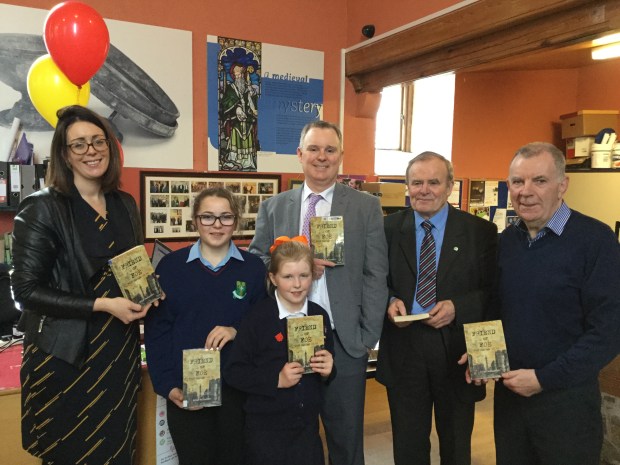
 Pupils, teachers, and librarians in Killenaule in County Tipperary have just finished a month-long One Book One Community project based on my 2106 novel, Friend or Foe. Well done to all involved in a very successful undertaking.
Writing
busy with words
My radio documentary BUSY WITH WORDS will be air on Newstalk 106-108fm on Sunday February 18th at 7.00 a.m. and will be repeated on Saturday February 24th. at 9.00 p.m. It can also be listened to as a podcast after the broadcast at Documentary on Newstalk.
BUSY WITH WORDS is a documentary about the resurgence of interest in the life and times of writer John D Sheridan. Featuring performances by renowned actor Des Keogh, and with contributions from Sheridan’s surviving family, the programme explores the life of this once famous humourist and novelist, and also looks at how the community in East Wall reclaimed a part of their cultural heritage, by republishing Paradise Alley, one of Sheridan’s books that was set in the area.
Tracing the author’s life from when his Donegal family arrived in early twentieth century Dublin, we hear from historian Sean Boyne about Sheridan’s attending O’Connell’s school during the 1916 era, and from Caitriona Ni Cassaithe about social conditions, and his teacher training, in the then very conservative St Patrick’s college.
Joe Mooney of the East Wall Historical society tells of how John D Sheridan taught in East Wall school, and we hear colourful reminisces from 90 year-old past pupil Charlie O’Leary, who went on the be the kitman for the Ireland soccer squad during the Jack Charlton era.
Joe Mooney recalls how Sheridan’s novel Paradise Alley pre-dated Strumpet City by twenty years in dealing with the 1913 Lockout, and present-day pupils from East Wall school read one of Sheridan’s light-hearted poems.
Actor Des Keogh, who adapted many of John D Sheridan’s humorous essays for the stage, reads one of his most famous pieces, I Know How You Feel.
John P Sheridan, the author’s son, reflects on what it was like living with a famous father, and Joe Mooney tells of how everyday life in East Wall found its way into Sheridan’s fiction. Poverty and bad working conditions were serious problems in the East Wall of that era, and Sheridan’s righteous anger at the lack of opportunities afforded his pupils comes across in readings from Paradise Alley, by Brendan Laird, an actor and past of the school.
Caitriona Ni Cassaithe and Joe Mooney tell of the local reaction to the republishing of the novel, and the last word is left to Charlie O’Leary, who compares Sheridan to James Joyce and Sean O’Casey, and who states that we can’t do enough to bring John D Sheridan back to the forefront.
Quotes from BUSY WITH WORDS:
“I’m only meeting him for the first time, and I nearly fell in love with the man after one day. It shows you how a child can be affected.” Charlie O’Leary, former Ireland kitman and past pupil.
“If anyone were to ask me to name one person who I think of as a supreme essayist, it would be John D. Sheridan”. Des Keogh, actor and broadcaster.
“The main characteristics that were imbued in the students were that they had to be middle-class, religious, show few signs of dissent and be manly.” Caitriona Ni Cassaithe, St Patrick’s College.
“The houses were probably the first houses in Ireland, designed by women, to suit women.” Joe Mooney, East Wall Historical Society.
“You don’t think of your father as a very famous man…he was just somebody you might be kicking football with in the back garden.” John P. Sheridan, author’s son.
BUSY WITH WORDS was edited and produced by Brian Gallagher. The programme was funded by the Broadcasting Authority of Ireland with the Television License Fee.

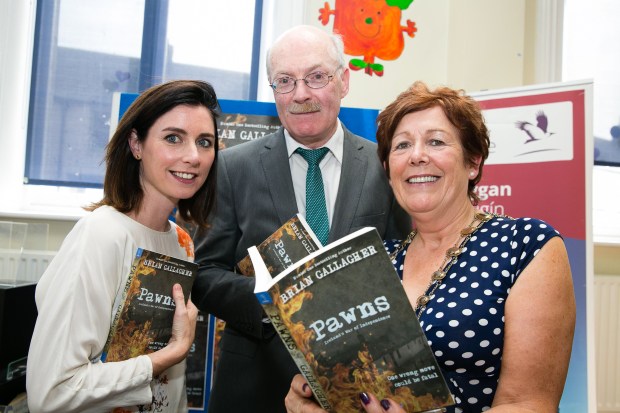 On Wednesday 23rd of August Pawns was launched i n Balbriggan Library by the Mayor of Fingal, Mary McCamley. Great to have the book launched in a location that actually features in the novel! (more…)

visit to friends’ school
world book day
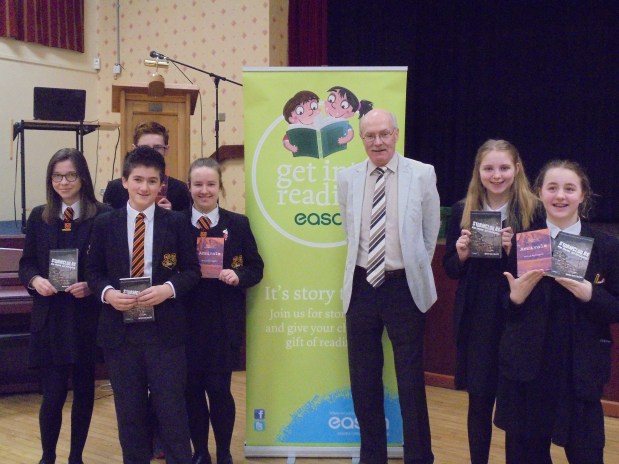 World Book Day was less hectic this year than in 2016, when I wrote One Good turn, the Irish entry for World Book DayA. World Book Day 2017 was still an active day, however, and I had the pleasure of meeting pupils in Killicomaine Junior High School in Portadown.

Canadian launch of Arrivals
Just back from Canada where Arrivals was launched in the grounds of Lakefield College School, by Mary Smith, the Mayor of Lakefield. Also present in the photo are John Boyko, former Dean of History at the college, and Phyllis Williams, Chief of the Ojibwe at the Curve Lake Reserve.
It was exciting to have the launch in the very location where so much of Arrivals plays out, and an honour to have such important dignitaries present. The event was covered by the Lakefield Herald and What’s on in Peterborough, with television coverage on Chex TV’s popular evening show, Newswatch.
The launch was followed by a reading, a lively questions and answers session, and drinks on the deck of the boathouse. Even the weather was perfect, with a golden sun dipping below the horizon just as the event finished!
VISITING BLACKROCK COLLEGE
I gave a talk to Transition Year students in Blackrock College on writing historical fiction, drawing on themes from Friend or Foe and One Good Turn, with particular emphasis on the topic of looting during the 1916 Rising.
The students were engaged and had lots of questions, and I even had my picture taken beside the plaque to the infamous Ross O’Carroll-Kelly!
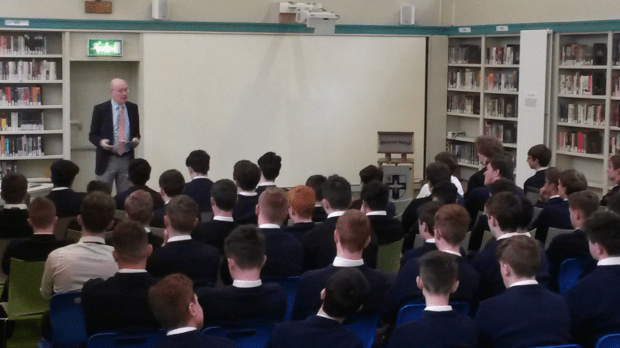
Blackrock College Transition Year talk

UK Summer Reading Challenge
I’m delighted to announce that my novel, Friend or Foe, has been chosen as one of the books for the UK Summer Reading Challenge.
This is a hugely popular scheme in which three quarters of a million children go into libraries to keep up their reading skills and confidence during the holidays. The Summer Reading Challenge takes place every year and children sign up at their local libraries, then read six library books of their choice, collecting stickers and other rewards along the way – all FREE.
And now, all year round, the Summer Reading Challenge website helps children keep track of their reading, find new books to read, take part in competitions and play games.
Publishers from across the UK submitted over 200 finished books, manuscripts, and top secret early proofs to consider for the 2016 collections. With help from librarians and children from Chatterbooks children’s reading groups, the submissions were narrowed down to just 72 titles – and I’m flattered that Friend or Foe has been chosen for this year’s list.
Here’s a picture of some of the covers, with Friend or Foe the first book on line four.

Mountains to Sea Festival
 As part of last year’s Mountains to Sea literary festival, Brian was a guest speaker, along with Marita Conlon McKenna and Nicola Pierce.
The subject was writing historical fiction.
A sold out talk was given in the Pavilion Theatre.
This was followed by a lively event for families in the new Lexicon Dun Laoghaire Library.
Writing historical fiction for young readers
Writing historical fiction for young readers provides opportunities, challenges and ultimately great satisfaction for an author.
In recent years, I’ve been working my way through twentieth century Irish history in my historical fiction. To date I’ve written four novels: Across The Divide (set during the 1913 Lockout), Taking Sides (set during the Irish Civil War), Secrets and Shadows (set during the Second World War), and Stormclouds (set in 1969, during the first year of the Troubles in Northern Ireland).
Although my books have a historical background, I’m always at pains to point out that they’re not history books – rather they’re stories about ordinary children who live their lives against a backdrop of major historical events. This can provide an environment that is rich in excitement and suspense, and which provides opportunities to force the characters into making big moral choices. But the history is always in the background, with the emphasis firmly on the characters and their lives.
However, by seeking to make the books page-turners, with fast paced, gripping plots, the history ends up being absorbed as a by-product – an approach that many teachers say works well with their pupils, with the result that children often enquire about historical events in which they would otherwise have shown little interest.
So, what’s the process in creating a novel of this kind? Firstly, I try to find a major event that has life-and-death elements involved, as this will provide possibilities for drama and conflict. Then I ask, “Will the historical event provide enough mileage?” A single incident that might make a good short story won’t have enough twists and turns to sustain a book that is a few hundred pages long. So the subject matter has to lend itself to playing out over a period of time, during which the readers invest emotionally in the characters. That way when historical events conspire to present the characters with difficulties, the readers really care about what happens to them.
Having chosen my era, I then carefully populate it with interesting people. This is critically important, and I spend a lot of time writing out many details of their imaginary lives before I write any scenes for them. But as well as being interesting characters they must be characters of their time. So if it’s Dublin in 1922, there can’t be Waynes, Crystals, Jordans or other modern-sounding names. It has to be Maureens, Liams, and Eileens – names that match the era.
As a historical novelist, I think that recreating the era successfully is the most challenging thing. But if you’re going to persuade the reader to suspend disbelief and enter your make-believe world, then that world really must ring true.In order to do this I try to find out what was going on during the period involved, from the songs of the day, to books and films that were popular, to the news stories that were breaking, and I weave these into my unfolding plot.
So, for example, when writing about the Lockout in 1913 I had my choir characters singing popular songs of the day, like “Has Anybody Here Seen Kelly?” and “Shine on Harvest Moon”. And when I found out that the Panama Canal opened during this period, I used that as part of a sub-plot to the main story.
Likewise, in trying to recreate the atmosphere of Belfast in 1969, I used songs such as “I Heard It Through The Grapevine” and “Where Do You Go To, My Lovely?” I also wove into the story the fact that during the summer of 1969 the first men landed on the moon – something that my fictional characters would clearly have been discussing.
In doing my research I visit libraries, use the internet and, where they are still alive, interview people who lived through the events. This can be the most rewarding form of research as it’s sometimes the smallest detail – like an old woman telling me that as a child she hated the smell of porter when the swing doors opened at her local pub – that can really bring a scene to life and make it feel real.
One of the dangers of all this research, however, is that the writer can be tempted to get too much value from it. Swamping the reader with your knowledge must be resisted, as must the inclination to become too nostalgic for the past.
The final challenge in historical fiction is artistic licence. Are you allowed to shape events to suit your story? Certainly I feel it’s acceptable to have your characters rub shoulders with real individuals. But actual history mustn’t be tampered with, and real people shouldn’t have words put into their mouths that they wouldn’t have said.
And so, having chosen my period, created my characters, done my research and worked out a plot, all that remains to be done is to write the novel. Just fifty thousand words to go then…
(c) Brian Gallagher
 Brian Gallagher